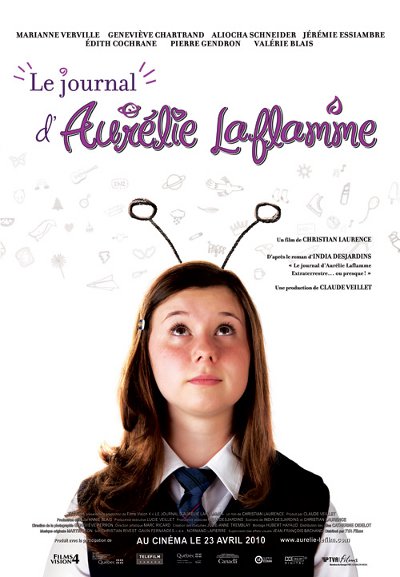
Journal d’Aurélie Laflamme, Le – Film de Christian Laurence

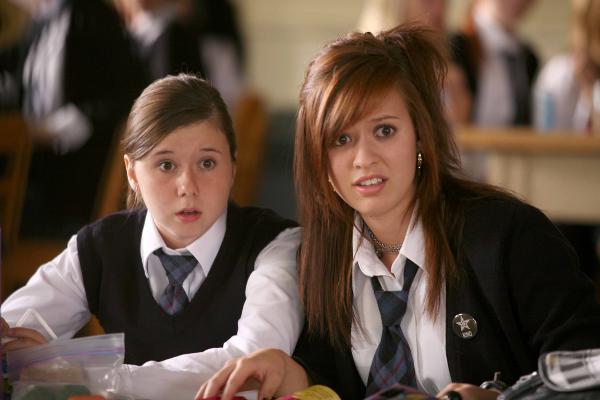
Le Journal d’Aurélie Laflamme est une comédie pour adolescents dont le personnage principal est tiré de la populaire série de livres écrits par l’auteure India Desjardins.

Le journal d’Aurélie Laflamme de Christian Laurence

Le journal d’Aurélie Laflamme de Christian Laurence

Le Journal d’Aurélie Laflamme est une comédie pour adolescents dont le personnage principal est tiré de la populaire série de livres écrits par l’auteure India Desjardins. Ce film est basé sur le premier tome de la série « Aurélie Laflamme, Extraterrestre ou presque ». Le réalisateur Christian Laurence vient du domaine de la télévision et signe ici son premier long-métrage de cinéma.

Comme on pouvait s’en douter d’après les succès obtenus par les livres, Le Journal d’Aurélie Laflamme fut reçu chaleureusement par le jeune public québécois qui en fit l’un des succès au box office de 2010. Au niveau international, le film de Christian Laurence eut droit à quelques sélections dans les festivals francophones, sans toutefois se démarquer outre mesure.

Un second film tiré des aventures d’Aurélie Laflamme a été produit par la suite.

Résumé

Aurélie est une adolescente de 14 ans, un peu perdue et donc en quête de solutions. Entre les habitudes de sa mère sédentaire et les chicanes avec sa meilleure amie, elle rêve à son premier french kiss ! Mais au fond, Aurélie se sent bien seule dans l'’univers, surtout depuis la mort de son père, il ya 5 ans.

Et si son père était simplement un extraterrestre, ayant quitté la Terre pour rejoindre sa planète? Génétique oblige, Aurélie serait elle-même une extraterrestre! Ceci expliquerait bien des choses. Par exemple, pourquoi elle se sent si différente des autres (surtout de sa mère), pourquoi elle n'’est pas capable d’'enligner deux mots sans faire une gaffe, et surtout pourquoi les garçons lui tapent vraiment sur les nerfs.

Synopsis officiel

Distribution

Marianne Verville (Aurélie Laflamme) ; Geneviève Chartrand (Kat) ; Aliocha Schneider (Nicolas) ; Jérémie Essiambre (Truch) ; Edith Cochrane (mère d’Aurélie) ; Pierre Gendron (Denis Beaulieu) ; Valérie Blais (Marie-Claude) ; Sylvie Potvin (Soeur Rose)

Fiche technique

Genre: Comédie dramatique - Origine: Québec, 2009 - Sortie en salles: 23 avril 2010 dans 83 salles au Québec - Durée: 1h48 - Classement: Général - Tournage: septembre-octobre 2009 - Budget approximatif: 4,1 M$

Réalisation : Christian Laurence - Scénario : Christian Laurence et India Desjardins, d'après le roman éponyme d'India Desjardins - Production : Claude Veillet et Lucie Veillet - Société de production : Films Vision 4 - Distribution : TVA Films

Équipe technique - Costumes : Julie-Anne Tremblay - Direction artistique : Marc Ricard - Montage : Hubert Hayaud - Musique : Martin Léon - Photographie : Geneviève Perron
Homeward Bound by Charlie Forde: A Heartwarming and Poignant Journey

We are living through an era of "quiet quitting" and burnout. “Homeward Bound” validates the feeling of driving toward a place—a relationship, a career, a mindset—that you have outgrown, simply because you don't know where else to go. It is the anthem for the weary traveler who has no destination, only a direction.

The Story

Throughout the novel, Oscar grapples with feelings of guilt, shame, and regret, which are expertly woven into the narrative by Forde. As Oscar navigates the complexities of his own emotions, he begins to realize that the journey home is not just a physical one but also an emotional and spiritual one. Along the way, he meets people who challenge his perceptions, offer guidance, and provide companionship, ultimately leading him to a path of redemption and self-discovery.

Forde's writing is evocative and immersive, conjuring up the lush Irish landscapes and the complex emotions of his characters with ease. The author's use of language is lyrical and poetic, with a keen sense of observation that brings the reader into the world of the story. The characters are richly drawn and multi-dimensional, with Michael and Luke's relationship at the heart of the novel.

The novel is set against the stunning backdrop of the Irish countryside, where the rugged landscape and unpredictable weather serve as a constant reminder of the harsh realities of life. Forde's vivid descriptions of the landscape transport readers to a bygone era, immersing them in the sights, sounds, and emotions of the characters' journey. As the siblings walk, the changing seasons and varied landscapes mirror their emotional journeys, from the bleakness of their current situation to the hope and promise of a brighter future.

Homeward Bound has received widespread critical acclaim for its thoughtful and moving exploration of the human experience. Reviewers have praised Forde's beautiful prose, well-developed characters, and nuanced exploration of complex themes. The novel has been described as "a heartwarming and poignant journey" (The Irish Times), "a beautifully written story" (The Guardian), and "a masterpiece of contemporary Irish literature" (The Irish Independent).

Context: Commissioned by the UK Labour Party and conducted by Martin Forde KC.

As readers, we are left with a profound appreciation for the complexity of human relationships, the weight of trauma, and the resilience of the human spirit. "Homeward Bound" is a novel that will stay with you, haunting your thoughts and emotions long after you finish reading it. It is a must-read for anyone who appreciates powerful storytelling, complex characters, and a deep exploration of the human condition.